
Otero County Release Date Labels
Colorado release-date records have labels that must not be collapsed into one "out date." A parole eligibility date is the first point when parole may be considered under the applicable statute and credits. It is not proof of release. A mandatory release date is a sentence-computation point that can still be affected by detainers, revocation, or new court action. An estimated sentence discharge date can point to the projected end of the sentence or supervision calculation. The actual release date is the custody event that occurred.
County jail cases are different from CDOC cases. A person booked into Otero County Detention Center may leave by bond, court order, sentence served, time served, transfer, probation, or transport to DOC. Those local jail outcomes are not computed by CDOC unless the person is sentenced to state prison. For a jail-only case, use booking, the court case, and sheriff records.
Find an Otero County Release Date
Start with the custody system, not the search box. Otero County does not publish an official online current roster or recent-release app in the official sources reviewed. CDOC Offender Search is powerful, but only for state prison, parole, and state discharge records. A person released from the county jail on bond, dismissal, time served, or a local probation sentence may never appear in CDOC.
- For current Otero County jail custody, call Detention Center Booking at 719-384-5941, option 3.
- For the court order behind release, search Otero Combined Court records and docket events.
- For a past jail release, request the booking or release sheet from Otero County Sheriff's Office records.
- For a state prisoner, search CDOC Offender Search by DOCNO, last name, first name, and gender.
- For a pending custody change, register through VINELink Release Check.
- For a federal sentence, use BOP instead of Otero County or CDOC.
The broader Otero County released inmate search path is useful when the person has already left the jail and the exact custody system is not clear.
Colorado Good-Time Release Rules
Colorado should not be described as a universal 85 percent state. The safer rule is more specific: release eligibility depends on offense date, offense type, sentence type, presentence confinement credit, earned time, parole-board action, detainers, and any later court orders. C.R.S. 17-22.5-403 is the parole eligibility statute. For many determinate felony sentences, it uses a fifty-percent eligibility point less earned time authorized under C.R.S. 17-22.5-405. Some serious categories and timing rules use different structures, including seventy-five-percent eligibility for certain violent categories.
Earned time affects the calculation but does not erase the court sentence. CDOC applies the statutory framework and its own sentence data to the person-specific record. The court mittimus, jail credit, offense date, offense class, parole board status, parole plan, institutional conduct, detainers, and sentence corrections all matter. For Otero County readers, the practical check is the CDOC result plus the sentencing document, not a formula from a county webpage.
The C.R.S. 17-22.5-403 parole eligibility source provides the statutory basis for many Colorado release-date calculations.
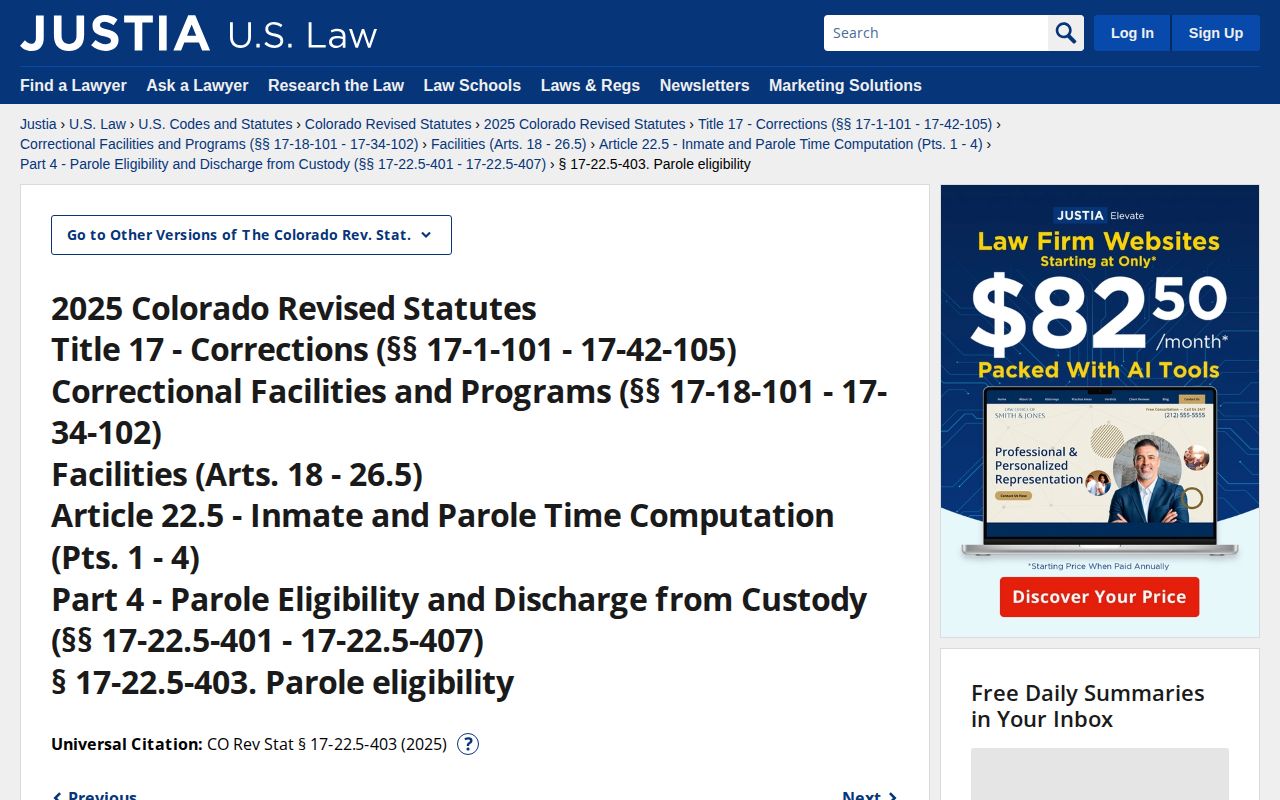
The statute shows why Colorado release dates must be tied to the exact sentence category instead of a single statewide percentage.
Why Otero County Dates Change
A projected release date can move before or after a person appears to be close to release. Some changes are routine sentence calculations. Others happen because a court, parole board, jail, or another agency changes the person's custody path. A release date can also be misunderstood when a person leaves Otero County jail for DOC, another county, federal custody, or immigration custody.
| What changes the date | Why it matters |
|---|---|
| Presentence confinement credit | Credit may be added, corrected, or disputed after sentencing. |
| Earned time | Credits may be awarded, withheld, restored, or affected by disciplinary history. |
| Parole board action | Release may be granted, denied, deferred, rescinded, or tied to plan approval. |
| Detainers and holds | Another case or agency can prevent return to the community even when one sentence changes status. |
| Sentence corrections | Concurrent or consecutive sentence issues, amended mittimus entries, or later orders can alter the calculation. |
| Revocation | A parole or probation violation can return a released person to custody and create new dates. |
Note: Pretrial Otero County detainees usually have no fixed release date until bond, court order, or another release authority exists.
Confirm Otero County Release Dates
Confirmation depends on what the date is supposed to prove. If the question is whether a person is still inside Otero County Detention Center, booking is the direct local contact. If the question is why the person was released, the court case and sheriff release record are more useful than a status alert. If the question is state prison parole or discharge, CDOC Offender Search and the parole calendar are the correct public sources.
Use Colorado VINE when a person is still in custody and the goal is notice of a release, transfer, or other custody change. VINE can help with timing, but it does not provide the full court disposition, sentencing order, or booking file. After a VINE alert, check the originating agency. For a state-prison release, confirm status through CDOC. For a jail release, confirm with Otero County booking, sheriff records, or Otero Combined Court.
State Discharge Release Prep
C.R.S. 17-22.5-202 adds a release-preparation detail for Colorado state prison cases. Before a person is entitled to discharge or parole, CDOC provides a "ticket of leave" ten days before the date. The statute also addresses clothing, transportation within Colorado to a residence or another Colorado place, and a discharge payment for discharged persons other than parolees, subject to statutory limits. This is a state-prison release logistics rule, not an Otero County jail release rule.
The C.R.S. 17-22.5-202 ticket of leave source documents the state discharge and parole preparation rule.
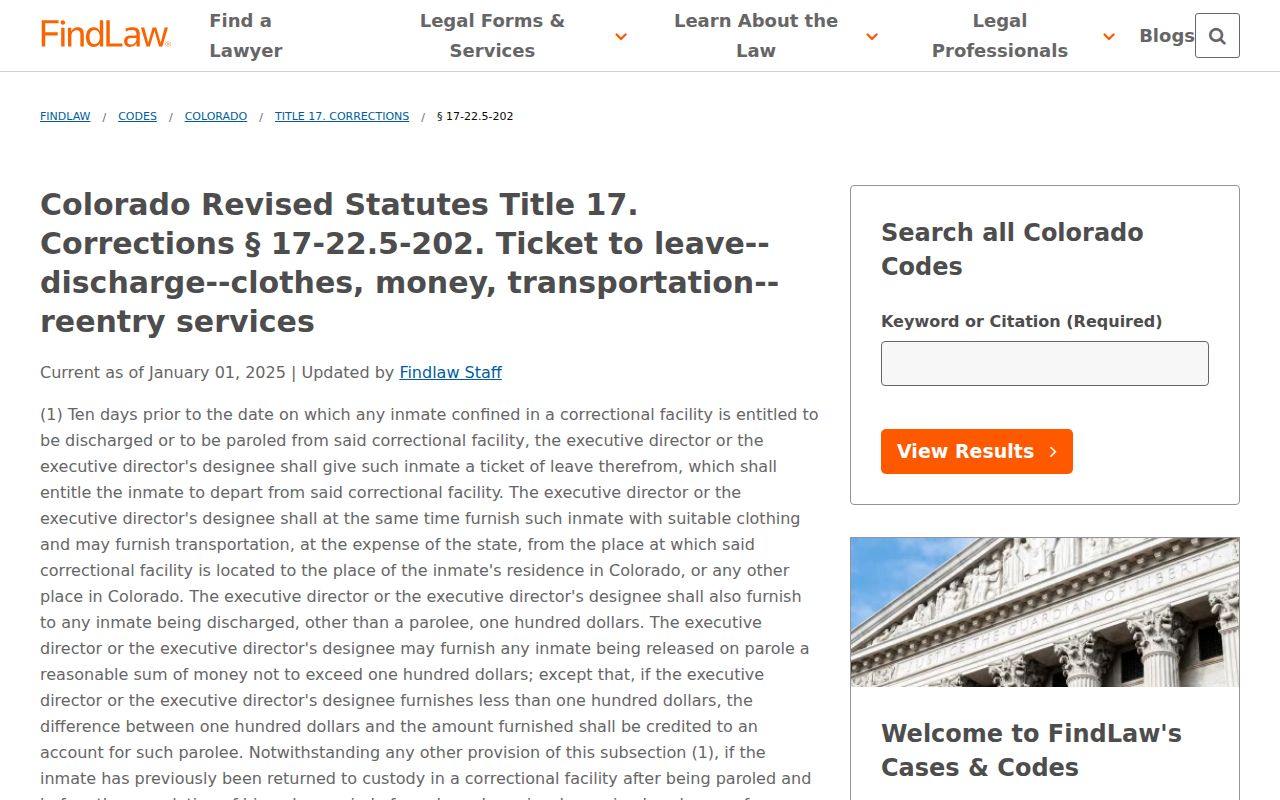
This state release-preparation rule should not be used to predict a local jail release from the Otero County Detention Center.
County Jail vs CDOC Dates
Otero County jail release dates for short local sentences are controlled by the court sentence, jail credit, bond orders, local calculation, and holds. They are checked through booking, court records, and sheriff records. CDOC dates apply when a person is committed to Colorado state prison, is on parole, or has a state sentence discharge question. A person can disappear from the local jail because of transport to DOC, not because the person returned home.
- Parole eligibility date
- The first point when parole may be considered under the sentence law. It is not actual release.
- Mandatory release date
- A state sentence-computation date that may still be affected by holds or revocation.
- Estimated sentence discharge
- A projected end point for the sentence or supervision calculation, subject to agency records.
- Time served
- A local court or jail outcome where custody credit can satisfy a jail sentence.
CDOC Fields to Compare
CDOC Offender Search starts with DOCNO, last name, first name, and gender. A DOC number is the cleanest search key because name matches can be broad. Once an individual record is found, read the date fields with the status, facility or parole office, current convictions, and sentence data. A date field without status can mislead readers because parole eligibility, mandatory release, and discharge are not the same event.
| CDOC field | Release-date use |
|---|---|
| DOCNO | Confirms the state offender record and reduces name-match errors. |
| Status | Shows whether the person is in custody, on parole, released, or discharged as labeled by CDOC. |
| Facility or parole office | Separates prison custody from parole supervision or another listed location. |
| Parole eligibility date | Shows when parole may be considered, not when release must occur. |
| Mandatory release date | Shows a computed release point that still must be read with holds and status. |
| Estimated sentence discharge | Points to the projected end of sentence or supervision calculation. |
For Otero County jail-only cases, these CDOC fields may not exist. That is not a failed search. It means the local release date has to be checked through the jail, the sheriff records request, or the Otero Combined Court record.
Parole Hearings and Dates
The Colorado State Board of Parole calendar can explain why a state-prison release date is not final even after a person reaches eligibility. The calendar lists hearing months after scheduling is set and warns that hearings and schedules can change. A hearing may be an application hearing, full-board review, rescission hearing, or revocation hearing. A grant can still depend on plan approval and holds. A deferral, denial, or rescission can move the release path.
Use the CDOC parole hearing calendar with the person's CDOC record, not by itself. The calendar can show a pending public hearing route, while the offender record and court mittimus identify the person-specific sentence. Otero County local parole questions can route through the county directory's parole phone, but state-prison status still belongs to CDOC and parole-board records.